English, Spanish, French, Italian, German and Portuguese: six complete courses, each one from first contact to full mastery — with an AI that listens to your voice and shows you, word by word, what to fix.
Start in your browser, with nothing to install — or in the app, on iPhone and Android.
 🇬🇧 Hello
🇪🇸 Hola
🇫🇷 Bonjour
🇮🇹 Ciao
🇧🇷 Olá
🇩🇪 Hallo
🇬🇧 Hello
🇪🇸 Hola
🇫🇷 Bonjour
🇮🇹 Ciao
🇧🇷 Olá
🇩🇪 Hallo
Kangoo wasn't designed for one country and translated afterwards. You choose the language you want to learn and also the language you want to be taught in — and the two choices are independent. An Italian learning English and an American learning Portuguese use the same app, each in their own language.
English, Spanish, French, Italian, German and Portuguese, each with its own complete course, from A1 to C2.
Portuguese, English, Spanish, Italian and French. The explanation arrives in the language you already speak, which is what makes the rule make sense.
On the website, the price is shown in your country's currency before you confirm. In the app, billing is handled by Apple or Google, at your country's store price.
Each language has 180 modules covering the six levels of the European Framework, from A1 to C2, with thirty modules per level. Each module brings five lessons, a checkpoint and a speaking challenge — 900 lessons per language.
The same ladder exists six times, once per language. And nobody has to start from zero: a placement test with questions from every level shows you where to begin.
From your first "hello" to phrasal verbs — and, at the top, reading contracts and writing a long-form essay.
From your daily routine to negotiating at a high level, with ser and estar getting a module of their own.
From your first sentences to defending a position and writing with style, with idioms along the way.
From a coffee ordered at the counter to literary criticism and humor in Italian.
"Du" or "Sie" from the very first module, the gender of nouns and, up at C1, the German spoken in Switzerland.
From your first conversation to literature, with Machado de Assis, and classical rhetoric.
The lesson teaches. The AI is where you test yourself against something that answers back. Each feature solves a different problem, shows up at a different moment, and pays off far more once you know how to use it.
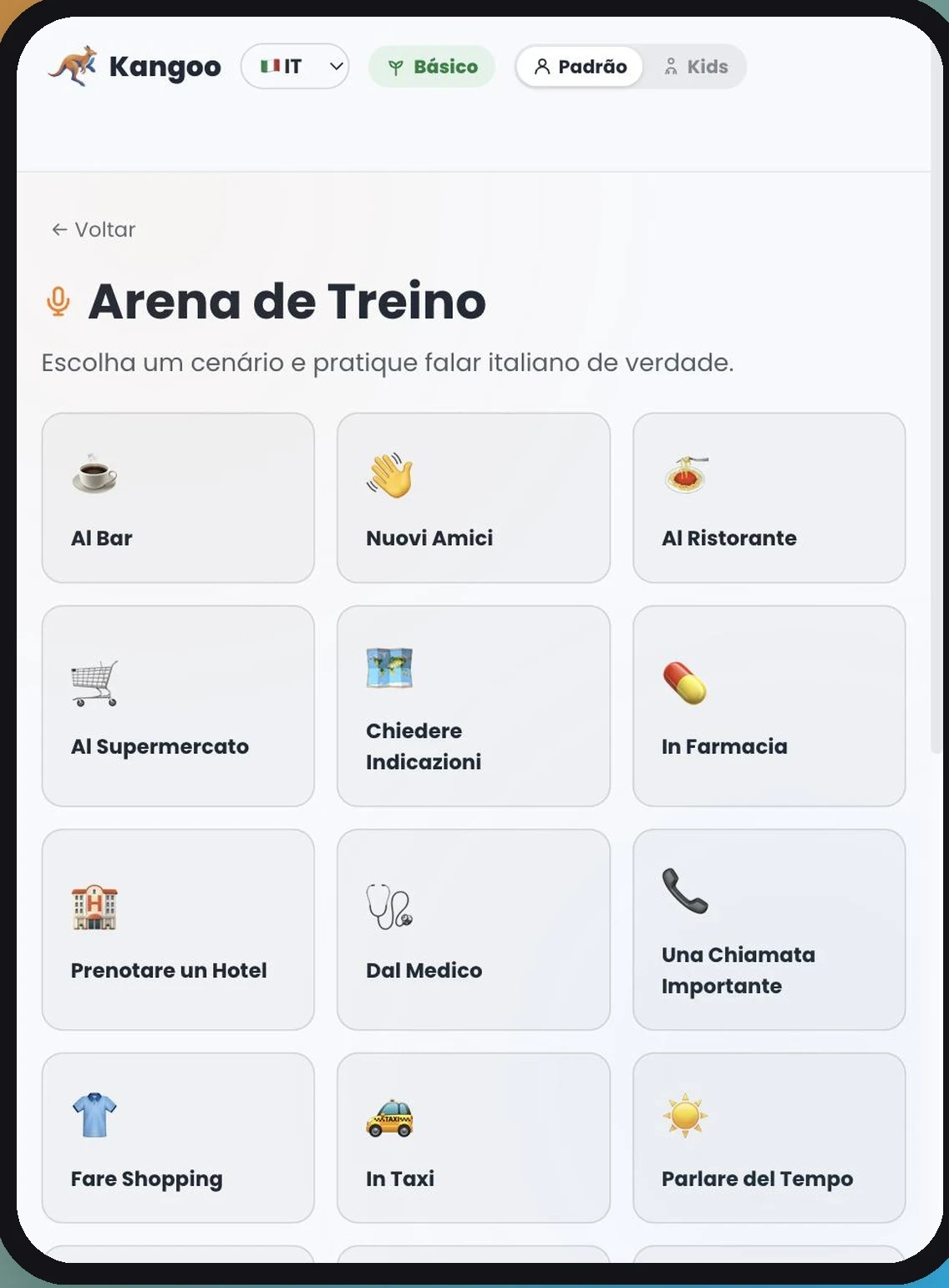
Ordering at a café, booking a hotel, explaining a symptom at the pharmacy, facing a job interview. You pick the scenario, actually speak into the microphone, and get back what you got wrong — word by word. It's the part of a language that reading and listening don't train.
How to get the most out of it: don't repeat the whole sentence until the score goes up. Look at which word turned red, say only that word slowly five times, and only then redo the sentence.
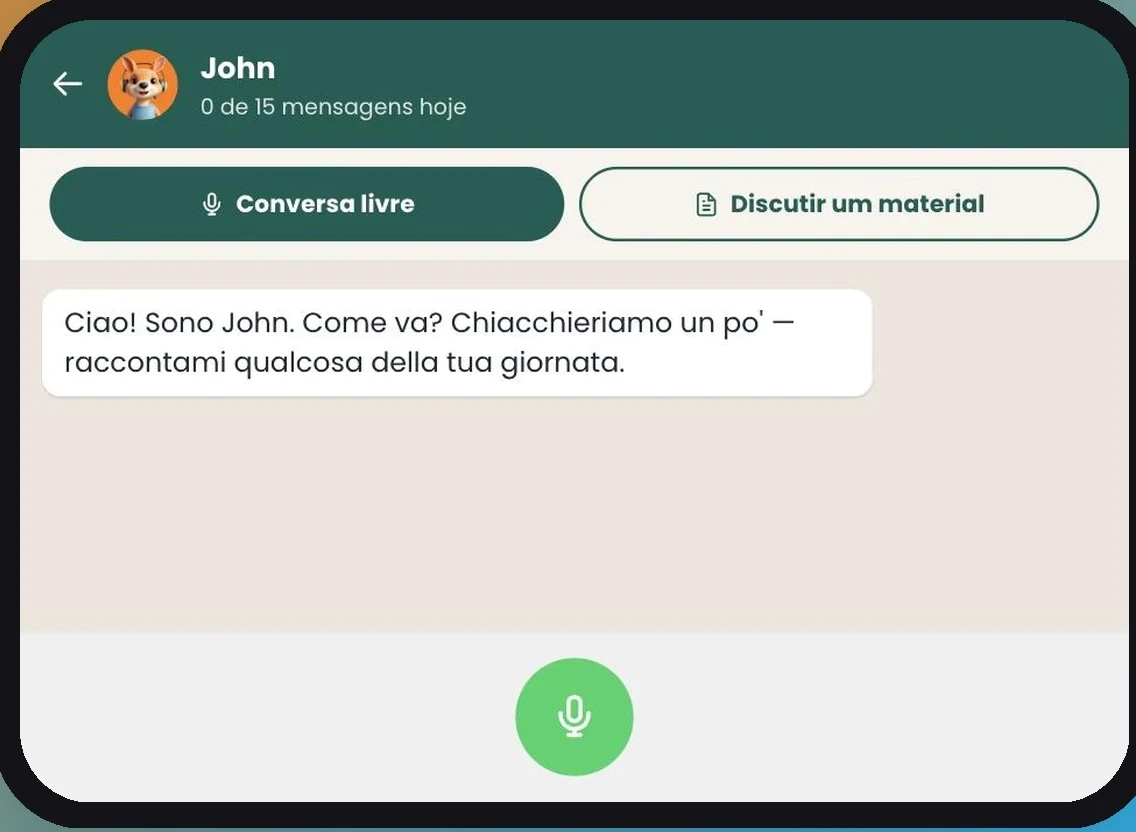
John answers by voice or by text, remembers what you told him in earlier conversations and never gets tired of repeating. You can chat about anything or bring up whatever topic you want — no audience, no embarrassment about mistakes, at your own pace.
How to get the most out of it: bring John the topic of the module you just finished. New vocabulary sticks better when you use it outside the exercise where you learned it.
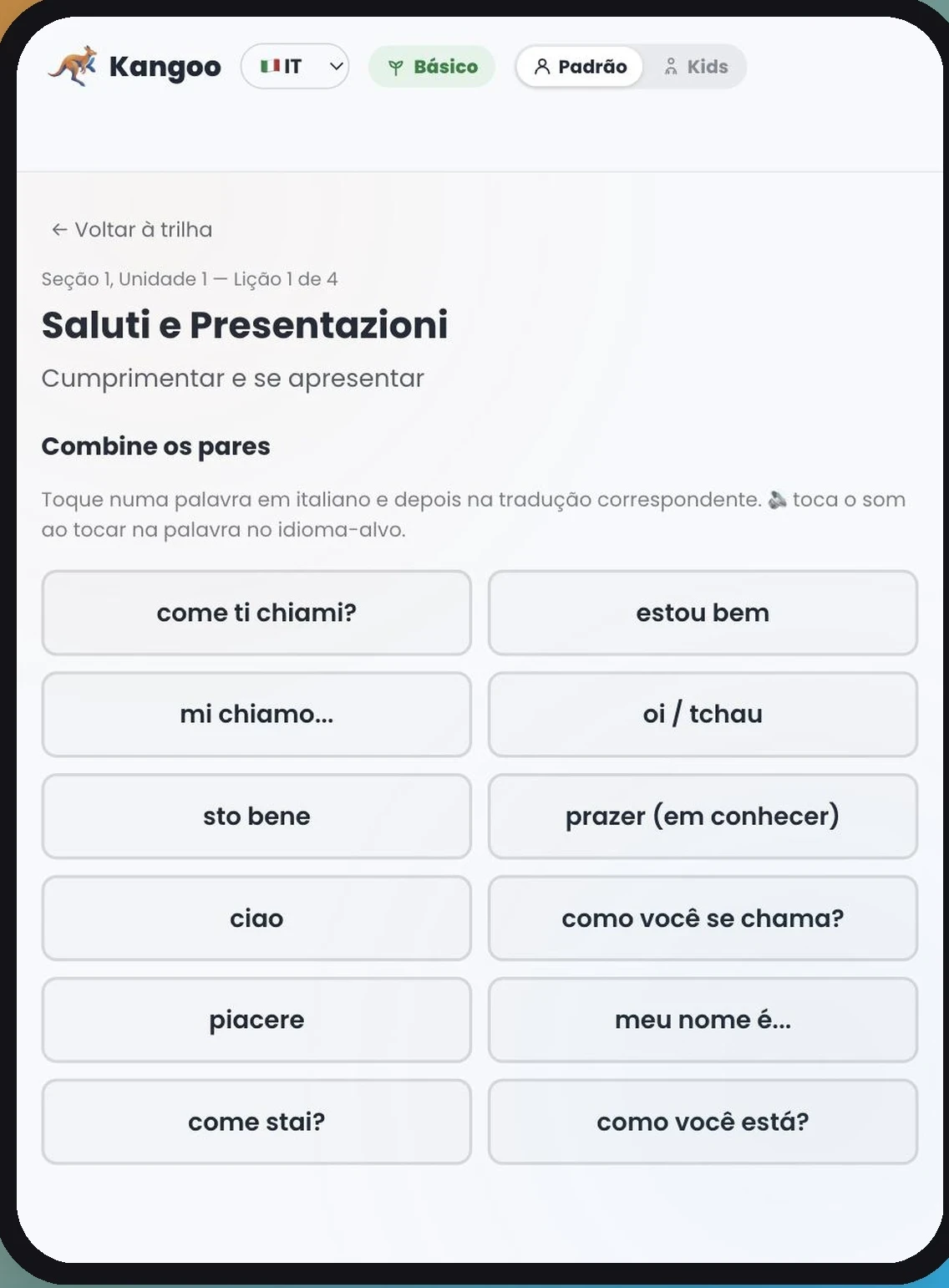
Every lesson asks for an active answer: fill in, choose, put the sentence in order, speak. No just tapping "got it" and moving on. And every module ends with a checkpoint and a speaking challenge, so you actually use what you just learned.
How to get the most out of it: try to answer before looking at the options. The effort of remembering is what makes the answer stay.
Kangoo's speech assessment runs on Microsoft Azure AI Speech, analysing at the level of the phoneme — the smallest unit of sound in a language. It isn't a "right or wrong": every attempt comes back with four scores from 0 to 100 and with the score of each word separately, so you can see exactly where the sentence went off, instead of only knowing that it did.
Questions from every level, A1 to C2, graded by the server. The result shows where on the path it makes sense for you to start.
How to get the most out of it: don't guess. A lucky guess puts you at a level that will frustrate you.
Outside the lessons. Each word comes back when the chance of forgetting it starts to grow, calculated by a memory half-life model.
How to get the most out of it: five minutes every day pay off more than an hour on Sunday.
Inside the dialogues, tap a word to see its translation and usage in your language — without leaving the lesson.
How to get the most out of it: try to guess from context before you tap. The effort is what makes it stick.
You can start right now. Free, in your browser or in the app, no card needed.
Start nowIt isn't the adult course with cartoons around it. Young children don't learn a language by reading instructions — so the kids' path was built a different way, from scratch.
There are 80 kids' modules in each of the six languages, all on the step that comes before A1 (Pre-A1): children start with pictures and sounds and work their way up to reading, at their own pace.

No adult menus and no long instructions. Children start by recognizing pictures and sounds, move on to words, then sentences, and only then read — and their profile tells the app whether they can already read or not yet.
The teaching follows Cambridge's guidelines for assessing children — volume 47 of Studies in Language Testing (Papp & Rixon, 2018) and Research Notes 28, on the Young Learners exams. Two decisions come from there that look like details and aren't: varying the format is what proves the child understood, not decoration; and short sessions respect the real attention span at that age.
Kangoo Kids comes with any subscription — Basic, Premium or Family — and the same account serves the adults and the children at home.
Gamification keeps learners coming back. It isn't what makes them learn. What makes them learn are four principles well established in learning research — two of them, retrieval practice and spacing, are among the most replicated findings in the field. They don't decorate the product: they guide how every Kangoo lesson is written and reviewed.
Answering from memory fixes more than rereading. That's why every lesson asks for an active answer — multiple choice, fill in the blank, put the sentence in order — and every module ends in a checkpoint.
What you learn needs to come back at growing intervals. Vocabulary is brought back by a memory half-life model, when the chance of forgetting starts to matter.
A topic doesn't show up once and vanish. Restaurants, travel or shopping come back later with deeper vocabulary, instead of being exhausted in one go.
Each lesson starts from what the learner already knows and adds one step — instead of stacking several new concepts on the same screen.
A good method is no use to someone who quit in week three. If learning science takes care of how you learn, this part takes care of carrying on learning — and the two are not the same thing.
All your XP for the week goes into a ranking of people at the same stage of the course as you — not people who've spoken the language for ten years. It restarts every Monday, so it's never too late to join.
Challenge someone to a round of quick questions. The questions come from our own question bank, and the draw favors the ones neither of you has seen yet.
You haven't practised today. 12 days of your streak are at risk — it takes less than 5 minutes.
nowWhen your streak is at risk, the reminder tells you how many days you're about to lose — in your interface language. And you can turn it off whenever you want, in settings.
Start today and your first streak starts today. Free, no card needed.
Start for freeBasic opens the whole course. Premium adds practice beyond the path: the Speaking Arena and conversation with John. And both come in a Family version, for up to five people.
To get to know the method before deciding, no card needed.
The whole course for the language, A1 to C2, with pronunciation assessment.
Everything in Basic, plus the practice that doesn't depend on the track.
The same Basic or the same Premium, for up to five people at home.
On the website, the price is shown in your country's currency before you confirm; in the app, billing is handled by Apple or Google. Website purchases come with a 7-day guarantee (14 days in the European Union, the EEA, Switzerland and the United Kingdom). And you can cancel whenever you want, with no penalty.
No card and no commitment, so you can see whether you like it.
It works on your computer, on your phone and in the apps for iPhone and Android. Your progress lives in your account, so you can start on one and continue on another.
It's free and complete, and the first two lessons of every other module are open as a sample. You can feel the method before deciding anything.
Basic opens the whole course; Premium adds the Speaking Arena and John. You can cancel whenever you want.
Of our competitors too. If an app doesn't answer these well, the problem shows up in month three — not month one.
The first module of each language, complete, and the first two lessons of every other module, as a sample.
We don't ask for a card for that, and you can start in your browser, with nothing to install.
Both. Kangoo works right in your browser, on a computer or a phone, and there's also an app for iPhone and Android, on the App Store and Google Play.
Since your progress, streak and XP live in your account and not on the device, you can start on your computer and continue on your phone, right where you left off. Just sign in with the same account on both.
Three things, in this order.
1. The course is truly structured on the CEFR. These aren't made-up "beginner, intermediate and advanced" bands: each language has 180 modules mapped to the six levels of the Common European Framework of Reference, thirty in each, from A1 to C2 — the same standard exams and universities use. You always know where you are, because that point has a name recognized outside the app.
2. The method follows principles with proven effectiveness in research. Retrieval practice and spaced review are among the most replicated findings in the science of learning, and they — together with the spiral curriculum and moving up one step at a time — guide how every lesson here is written.
3. You speak at the end of every module. All 180 of them. Almost every app keeps exercises on one side and AI conversation on the other — learners do exercises for months and never cross over to speaking, which is exactly where they get stuck. Here the two are stitched together, in four steps:
And the correction isn't "right or wrong": it's which word came out wrong, with scores for accuracy, fluency and completeness.
Basic opens the whole course — the language's 180 modules, from A1 to C2, with each module's checkpoint and speaking challenge and with pronunciation assessment. And it includes Kangoo Kids, for when you're not the only learner at home.
Premium adds what sits outside the path: the Speaking Arena, with its 23 scenarios, conversation with John and spaced vocabulary review.
If you study by following the track, Basic covers it. If you want to speak more than the track asks for, it's Premium.
It's the same Basic or the same Premium for up to five people at home. Prices for every plan are on the pricing page.
From A1 to C2, in all six languages — 180 modules per language, thirty in each level of the European Framework.
It's worth asking any app this before subscribing: many stop at intermediate, and you find the ceiling once you've already invested months.
We'd rather be honest: there are six languages — English, Spanish, French, Italian, German and Portuguese. If you want Swahili or Korean, we're not the right fit yet.
A catalogue of thirty languages looks impressive in the store and changes nothing for someone who is going to study one. What changes things is how deep that one goes.
There's a path of its own, for children aged 5 to 7, that starts before any language level: with pictures and sounds, and no adult menus.
There are 80 modules in each of the six languages, all on the Pre-A1 step: from picture to word, from word to sentence and from sentence to reading, at the child's own pace.
A shrunken adult course doesn't work for young children, and it's a question worth asking any app before subscribing with your kids in mind.
On the website, payment is processed by Paddle, our reseller, and the price is shown in your country's currency before you confirm. In the app, billing is handled by Apple or Google.
You can cancel whenever you want, with no penalty: renewal stops and access continues until the end of the period you've already paid for. Website purchases come with a 7-day guarantee and a full refund (14 days in the European Union, the EEA, Switzerland and the United Kingdom). For purchases made in the app, refunds follow Apple's or Google's rules.
The first module is free and complete. No card — just open it and speak.
Start for free In your browser, on iPhone and on Android.